The Transport Foundation for a Growing Fertility Network
Fertility networks often grow faster than the operational systems beneath them. A new site joins the organization, patient volume rises, services become more distributed, and the processes that worked well in one clinic suddenly have to support a much larger clinical ecosystem. This is where growth becomes complicated. The visible parts of expansion may be carefully planned, but the daily movement of reproductive materials often reveals whether the network is truly operating as one organization or as a group of clinics connected by shared ownership.
Transport is one of the first places that difference becomes visible. Inside the laboratory, standards are explicit and deeply understood. Teams know how materials are stored, how identity is protected, how records are maintained, and how deviations are handled. Once reproductive materials leave the clinic, that same level of control has to continue through a very different environment. The process crosses physical distance, organizational boundaries, and handoff points that may sit outside the clinic’s direct line of sight.
For a single-site clinic, logistics may depend on relationships that feel familiar and reliable. But for a growing network, familiarity can no longer carry the entire process. The organization needs to know that a shipment originating from one location will be handled with the same rigor as a shipment originating from another, and that the record produced afterward will tell the full story without relying on someone’s memory or a trail of messages pulled together after the fact. This is the less visible work of scale: turning local competence into network-wide consistency.
That is why reproductive transport has to be treated as part of the network’s clinical infrastructure. As fertility programs expand, the ability to standardize how materials are handled, tracked, monitored, and documented becomes central to maintaining trust across sites. Growth can introduce small differences that are easy to miss in the moment (but difficult to defend later). A strong logistics framework helps prevent those differences from becoming embedded in the operating model.
Cryoport Systems gives multi-clinic networks that framework through an integrated global footprint, unified SOPs, and ISO 21973-certified workflows designed for sensitive biological materials. This approach ensures clinics implement a consistent process that reduces site-to-site variability and gives teams a stronger foundation for oversight, documentation, and audit readiness as the organization expands.
Transport Is Part of the Clinical Chain of Responsibility
There is a natural tendency to think of transport as something that begins after the clinic has done its work. In practice, transport extends the clinic’s responsibility into a different setting. The material remains clinically significant, and the expectations around the chain of identity, condition, custody, as well as the supporting documentation proving all of these, remain just as important. The only thing that changes is the environment in which those expectations must be maintained.
That shift matters for multi-clinic networks, as transportation decisions will impact laboratory operations, patient services, quality systems, and external logistics (to name a few). If transportation processes fall short, every team feels it. Lab directors may have questions about the condition history of incoming materials. Operations leaders may spend time resolving inconsistencies between sites. Quality teams may have to reconstruct shipment records from disconnected sources. Administrators may discover that expansion has increased shipment volume without giving the organization a more scalable way to govern it.
A standardized logistics model closes that gap by giving every site the same foundation. The expectations for preparation, monitoring, handling, documentation, and review are established before the shipment moves. Records are generated through a defined process rather than assembled retrospectively. When questions arise, the organization can respond from evidence instead of interpretation.
This is where Cryoport Systems’ integrated model becomes especially valuable. A provider with global reach can support movement across geographies, but reach alone does not solve the problem of variation. The real advantage comes from pairing that footprint with unified SOPs and ISO 21973-certified workflows, so that clinics can rely on a consistent standard wherever the shipment begins.
For networks that are expanding through acquisition, regional growth, or centralized service models, that consistency can save significant effort.
Audit Readiness Starts Long Before an Audit
The most difficult transport questions often come after the shipment is complete. When patient asks for reassurance, or a receiving clinic wants to verify handling history. Or maybe an internal review requires documentation from a prior movement of materials, or an auditor wants to understand whether the process described in the SOP matches what actually happened.
In those moments, the quality of the record matters as much as the shipment outcome. A clinic may know that materials were handled responsibly, but if the evidence is fragmented, the organization may still struggle to tell a clear story. That is where inconsistent transport practices create avoidable burden for growing networks.
Audit-ready documentation should be a natural output of the workflow. It should show how custody was maintained, how conditions were monitored, when key events occurred, and how any exceptions were addressed. When each site follows a different approach, producing that record can become harder than it needs to be.
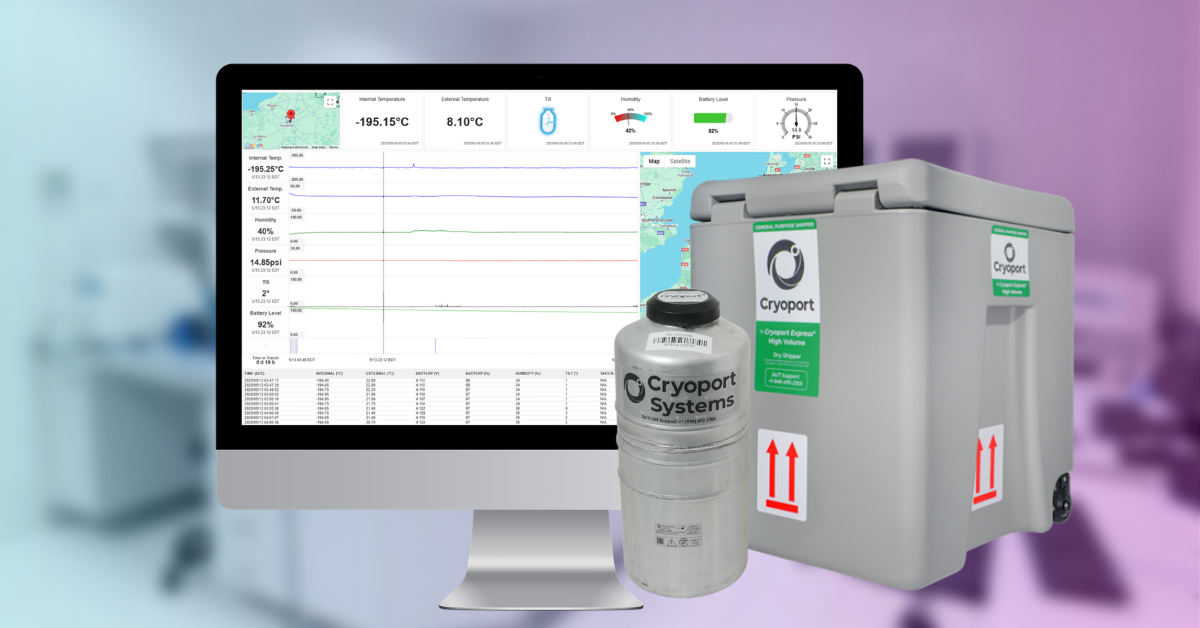
Cryoport Systems helps reduce that burden by standardizing the process across locations. Handling, tracking, monitoring, and documentation are managed within a controlled framework that supports review. When every shipment is managed within the Chain of Compliance® that brings together chain of identity, custody, and condition, with all data and records maintained in audit-ready form directly in the Cryoportal® logistics management system, oversight becomes more efficient. The records are built around a consistent operating model, which reduces the strain that often comes with managing separate site-level processes as the network grows.
ISO 21973-certified workflows add another layer of assurance by reflecting defined requirements for the transport and handling of sensitive biological materials. In reproductive medicine, where materials are irreplaceable and patient trust is hard-earned, that level of structure matters. It gives fertility networks a stronger basis for governance while helping reduce the variability that can otherwise follow growth.
Standardization Helps Networks Grow Without Adding Friction
A fertility network’s ability to scale depends on more than opening new sites or increasing capacity. It depends on whether the organization can preserve consistency as more people, locations, and workflows become part of the system.
Transportation has a direct role in that. Reproductive materials may move because a patient relocates, because treatment and storage are managed at different facilities, because services are centralized, or because a network is coordinating care across regions. As that activity increases, the organization needs a logistics model that can absorb complexity without creating new uncertainty at each site.
Standardization gives networks a way to grow with more control. It reduces the need to re-evaluate separate local providers, reconcile incompatible documentation practices, or explain why shipments are handled differently within the same organization. It also gives clinic teams a clearer way to communicate with patients. And that confidence is important. Patients may never ask about SOP harmonization or ISO-certified workflows, but they can sense when a clinic has command of the process. They want reassurance that their reproductive materials are being protected by a network built for what is being transported.
As fertility care becomes more connected, decisions around the transportation of reproductive materials will continue to shape how well clinical networks function across locations. The movement of reproductive materials is no longer an occasional operational task for many organizations. It is part of how modern fertility networks serve patients, integrate sites, and coordinate care across regions.
The clinics best positioned for sustainable growth will be the ones that treat reproductive transport as infrastructure. They will expect the same standard to apply wherever materials move and will build documentation into the process rather than chase it later. They will also carefully choose partners that can support scale without introducing site-to-site variability.
Cryoport Systems provides that foundation for multi-clinic fertility networks: an integrated global footprint, unified SOPs, ISO 21973-certified workflows, and a consistent model for handling, tracking, monitoring, and documenting reproductive material shipments. As networks expand, that consistency becomes a practical advantage and a meaningful safeguard.
Growth should not make reproductive transport harder to govern. With the right partner, it can become one of the systems that helps the network scale with confidence.