What Clinics Need to Know about Compliance and Audit-Ready Transport
Regulatory oversight in reproductive medicine doesn’t adhere to the same standards as other areas of human healthcare (like cell and gene therapy). That gap is narrowing. Inspections and accreditation reviews are only becoming more rigorous, and expectations around traceability, documentation, and proactive risk mitigation are converging with the standards long established for advanced therapies.
Transportation and logistics sit directly inside that shift. It’s one of the few points where custody of reproductive materials like embryos or gametes leaves the clinic’s controlled environment and enters a multi-party chain involving couriers, freight handlers, customs agents, and receiving facilities (to name a few). During the audit process, most findings tied to transport aren’t about catastrophic failures. They’re about the seemingly small things like missing records or inconsistent procedures, or even gaps between what is documented and what actually happened in transit.
The operational burden of closing those gaps falls on clinics. In reality, very few have the resources to design, validate, and fully implement a transportation framework that holds up under audit scrutiny without external infrastructure.
Where audit risk shows up in reproductive logistics
Audits tend to surface the same types of issues, like chain of custody documentation that stops at the clinic door and only resumes once material is received. Or handoffs that are loosely recorded or dependent on courier scans that were not designed to maintain traceability. Breaks in chain of custody, chain of identity, or chain of condition raise red flags for auditors if not proactively planned for and addressed.
Temperature control, for example, is usually assumed rather than documented. Clinics routinely rely on shipper specifications or vendor assurances, but cannot always produce lane-specific validation data or demonstrate that packaging performance holds under real-world transit conditions, including delays. If excursions occur, deviation handling procedures are often unclear, and supporting data may not meet the expectations of auditors if the narrative is being reconstructed after the fact from various disconnected sources or from different emails and inboxes.
None of these failures are unusual; they simply reflect the fact that most fertility clinics were not built to operate full logistics quality systems internally.
Why transport is being pulled into higher regulatory expectations
Reproductive materials are now moving across longer distances and between more specialized centers. Centralized labs, international patient flows, and inter-clinic (or inter-network) collaborations have expanded transportation frequency and complexity. And each additional touchpoint introduces variability.
Regulators and accreditation bodies are increasingly responding to that complexity by focusing on control and traceability. Concepts like continuous monitoring and an end-to-end chain of identity are no longer unheard of in reproductive transport. These are baseline in other areas of human medicine, and they’re increasingly becoming expected for reproductive materials.
This creates a practical problem for clinics. Building a compliant transportation framework requires capabilities that most clinics do not have in-house, including data capture infrastructure and 24/7 logistics oversight. Maintaining these capabilities at audit-ready levels requires ongoing validation and change control with stringent documentation discipline. Most clinics would have to recreate a scaled-down version of a life sciences organization to meet those expectations independently.
Standardization is what auditors actually look for
Across audits, consistency matters more than sophistication. A simple process that is implemented the exact same way every time (and with complete records and documentation) is easier to defend than a complex process with variability or where exceptions are handled in individual email inboxes rather than through a single system.
Standardized shipping and logistics processes address this directly. Validated packaging removes uncertainty about thermal performance, while a well-implemented chain of condition provides continuous evidence of the physical state of the material throughout transit. This establishes a defensible record that conditions remained within defined limits, and if they did not, that deviations were identified and managed according to procedure.
Chain of custody extends that same discipline to ownership and control, with every transfer time-stamped and verifiable. When an auditor asks who had responsibility at any particular point in transit, the answer is documented and doesn’t need to be reconstructed after the fact.
This level of rigor can make all the difference in passing an audit with minimal findings, as opposed to entering a remediation cycle that consumes operational time.
What changes when transportation is treated as part of a qualified supply chain
A qualified supply chain approach shifts responsibility for transport, including audit-ready documentation and continuous monitoring, to an infrastructure that’s built for it. The clinic interacts with a defined interface that incorporates standardized packaging, pre-defined and validated workflows, and integrated data outputs that directly support compliance and audit requirements.
Cryoport Systems operates within this model. Our custom-engineered shipping systems are validated and qualified using human medicine’s most stringent standards, rather than adapted from general cold-chain use. Performance is established under controlled testing, and that validation is maintained as part of an ongoing quality system that requalifies every shipping system before every use.
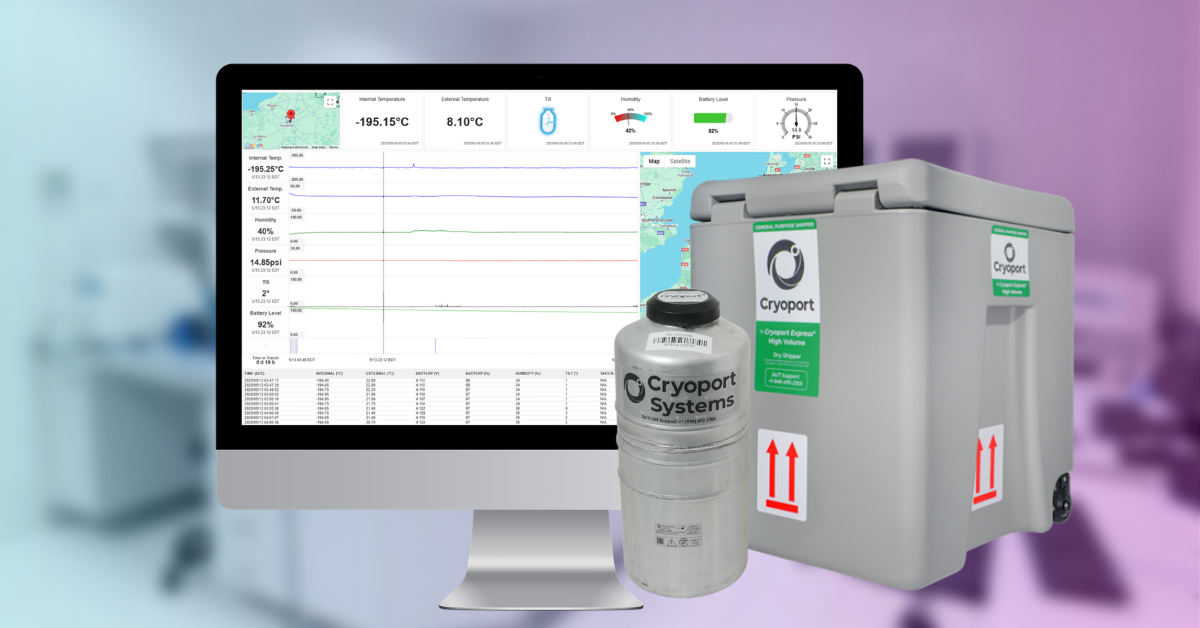
Shipments are monitored continuously, with data captured throughout transit rather than at isolated points. This produces a unified record of condition and custody that aligns with audit expectations, adhering to the proprietary Chain of Compliance® that meets the strict regulations of the human cell and gene therapy market. This means that data is never assembled after the fact. It’s generated as part of the process, in full compliance with ISO 21973 and other global compliance standards, for every shipment, every time.
The operational effect is that clinics do not need to build or maintain parallel capabilities, and procedures at the site level become streamlined as underlying complexity is handled within the supply chain itself. SOPs can simply reference standardized workflows and data outputs, tracked and maintained within the Cryoportal® logistics management system for compliance-ready reporting, and teams no longer need to try and govern each variable independently.
This does not eliminate responsibility. Clinics are still accountable for ensuring that processes are followed and that documentation is reviewed. What changes is the level of control they need to engineer for themselves.
How audit readiness shows up in day-to-day operations
Audit readiness is often thought of as a periodic state tied to inspections, but in practice, it reflects how consistently processes hold under routine real-world conditions. With standardized, validated transportation, records are generated in a form that aligns with compliance requirements without additional effort. Shipment data, custody logs, equipment performance history, and condition reports are all available as part of normal operations. When an audit occurs, documentation is simply retrieved rather than constructed from various systems and emails retroactively.
The trajectory is clear, even if timelines are not. Reproductive medicine is moving toward tighter alignment with broader human healthcare standards, and clinics that wait for formal requirements to catch up will end up compressing significant operational changes into short timeframes.
Adopting supply chain strategies that already meet higher standards avoids that headache. It also reduces the risk of incremental fixes that accumulate into a fragmented process.
Cryoport Systems effectively pulls those higher expectations forward. With validated cryogenic shipping systems that have been custom-engineered to protect sensitive reproductive materials, full Chain of Compliance controls, and continuous monitoring, transportation is already aligned with where regulatory expectations are heading.
For clinics, the practical benefit is not abstract readiness. It’s the ability to demonstrate, at any point, that reproductive transportation processes are controlled and documented, without having to engineer that system internally.
Transport is not the largest component of reproductive workflows, but it is one of the most exposed from a compliance perspective. The difference between a defensible process and a vulnerable one is usually not visible until an audit forces inspection. At that point, the distinction is entirely in the records.